IRIS Lab Summer 2026 Invited Seminar Series
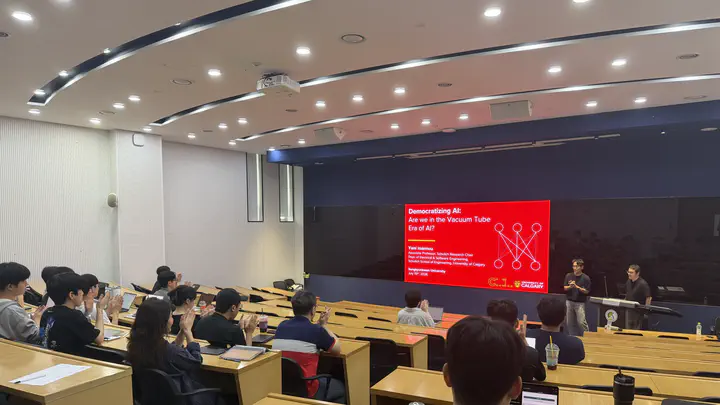
IRIS 연구실은 2026년 6월과 7월에 걸쳐 해외 연구자 여섯 분을 초청해 세미나를 열었습니다. 에너지 효율적인 컴퓨팅과 메모리 중심 AI 하드웨어, 신경망 양자화, 그리고 금융과 의료 분야의 AI 응용까지 폭넓은 주제를 다뤘고, 모든 세미나는 고종환 교수님이 호스트를 맡았습니다.
6월 15일 · Younghyun Kim 교수님 (Purdue University)
“Time-Accuracy Scalable Compute for Energy-Efficient Machine Learning"을 주제로, 반도체 미세화 이후 에너지 효율적인 머신러닝을 실현하기 위한 시간-정확도 확장형 컴퓨팅을 소개해 주셨습니다. 근사 컴퓨팅과 동적 정확도 제어, 시스템 전반의 최적화로 정확도를 유지하면서 지연시간과 전력을 줄이는 방법을 다뤘습니다.
7월 8일 · Atlas Wang 교수님 (XTX Markets · University of Texas at Austin)
“Algorithmic Trading with Large-Scale Deep Learning"을 주제로, 딥러닝과 파운데이션 모델로 수만 개 금융 상품의 예측을 만들고 완전 자동으로 거래하는 XTX Markets의 연구를 소개해 주셨습니다. 데이터 규모가 크고 잡음과 국면 변화가 심한 금융 시장에서 시계열 모델링과 대규모 최적화가 만나는 과제, 그리고 대규모 AI와 계량 금융이 맞닿는 지점의 연구 방향을 다뤘습니다.
7월 8일 · Bokyung Kim 교수님 (North Carolina State University)
“Beyond Intelligent Computing: Memory is the Center for Scalable, Efficient, and Trustworthy AI"를 주제로, 메모리를 단순한 저장 장치가 아니라 연산의 중심으로 다시 설계하는 연구를 소개해 주셨습니다. 3차원 메모리 소자와 회로, 이를 바탕으로 한 새로운 아키텍처와 실리콘 검증 사례, 프라이버시를 보존하는 AI 학습 시스템까지 회로에서 알고리즘에 이르는 전 계층 설계를 다뤘습니다. 교수님은 지난해 9월에 이어 다시 연구실을 찾아 주셨습니다.
7월 10일 · Huanrui Yang 교수님 (University of Arizona)
“From Static to Dynamic: A Journey of Accurate and Flexible Low-Precision Quantization"을 주제로, 파운데이션 모델 양자화에 관한 최근 연구를 소개해 주셨습니다. 정확도가 높은 사후 양자화 기법, mixture-of-experts 모델을 위한 혼합 정밀도 탐색, 하드웨어 자원 제약에 맞춰 실행 중에 정밀도를 바꾸는 기법을 다뤘고, 에이전트 추론 시대의 양자화 활용 전망으로 마무리했습니다.
7월 15일 · Yani Ioannou 교수님 (University of Calgary)
“Are we in the Vacuum Tube Era of AI?“라는 제목으로, MoE 모델의 원샷 압축에서 프루닝이 효과적인 이유를 다룬 ICLR 2026 논문과 그 연구가 AI 커뮤니티에 미친 영향을 소개해 주셨습니다. 이를 바탕으로 AI 모델을 더 많은 사람이 쓸 수 있게 하려면 무엇을 풀어야 하는지, 신경망의 과매개변수화를 어떻게 다룰지를 이야기했습니다. 교수님은 지난해 9월 세미나와 올해 5월 Calgary 방문에 이어 연구실과 교류를 계속하고 있습니다.
7월 20일 · Javed Mostafa 교수님 (University of Toronto)
“AI and ML approaches for Improving Biomedicine and Healthcare"를 주제로, 가설 생성과 진단, 치료, 환자 참여에 이르는 의료 전 과정에서 AI를 적용할 때의 과제와 새로운 방법을 소개해 주셨습니다. 학습하는 의료 시스템을 지원하기 위해 AI를 어떻게 활용할 수 있는지도 다뤘습니다.
바쁜 일정에도 연구실을 찾아 귀한 강연을 해 주신 여섯 분께 깊이 감사드립니다.
IRIS Lab hosted six invited seminars in June and July 2026, welcoming researchers from overseas institutions. The talks covered energy-efficient computing, memory-centric AI hardware, neural network quantization, and AI applications in finance and healthcare. Prof. Jong Hwan Ko hosted all of the seminars.
June 15 · Prof. Younghyun Kim (Purdue University)
In “Time-Accuracy Scalable Compute for Energy-Efficient Machine Learning,” Prof. Kim introduced time-accuracy scalable computing as a way to achieve energy-efficient machine learning beyond conventional semiconductor scaling. He showed how approximate computing, dynamic accuracy control, and full-system optimization can cut latency and power while preserving accuracy.
July 8 · Prof. Atlas Wang (XTX Markets · University of Texas at Austin)
In “Algorithmic Trading with Large-Scale Deep Learning,” Prof. Wang presented research at XTX Markets, where deep learning and foundation models generate forecasts for tens of thousands of financial instruments and trade fully automatically. He discussed the challenges that time-series modeling and large-scale optimization face in markets with massive data, high noise, and frequent regime shifts, and the research directions where large-scale AI meets quantitative finance.
July 8 · Prof. Bokyung Kim (North Carolina State University)
In “Beyond Intelligent Computing: Memory is the Center for Scalable, Efficient, and Trustworthy AI,” Prof. Kim presented research that rethinks memory as the center of computation rather than passive storage. The talk spanned the full stack, from 3D memory devices and circuits to new architectures with silicon demonstrations and privacy-preserving AI training systems. This was her second visit to the lab, following her seminar last September.
July 10 · Prof. Huanrui Yang (University of Arizona)
In “From Static to Dynamic: A Journey of Accurate and Flexible Low-Precision Quantization,” Prof. Yang shared his recent work on foundation model quantization. He covered highly accurate post-training quantization, mixed-precision search for mixture-of-experts models, and changing precision on the fly to fit hardware resource constraints, and closed with an outlook on quantization in the era of agentic inference.
July 15 · Prof. Yani Ioannou (University of Calgary)
In “Are we in the Vacuum Tube Era of AI?,” Prof. Ioannou discussed his ICLR 2026 paper on why pruning works well for one-shot compression of MoE models and the impact the work had on the AI community. Building on this, he talked about what needs to be solved to make AI models accessible to more people and how to address overparameterization in neural networks. His exchange with the lab continues from last September’s seminar and the lab’s visit to Calgary this May.
July 20 · Prof. Javed Mostafa (University of Toronto)
In “AI and ML approaches for Improving Biomedicine and Healthcare,” Prof. Mostafa described the challenges of applying AI across the healthcare pipeline, from hypothesis generation and diagnosis to treatment and patient engagement, along with new methods for tackling them. He also covered how AI can support a learning health system.
We sincerely thank all six speakers for taking the time to visit the lab and share their work.
