[C114] Computation-Efficient Shared Denoising and Classification for Frame-Based Event Sensors
Abstract
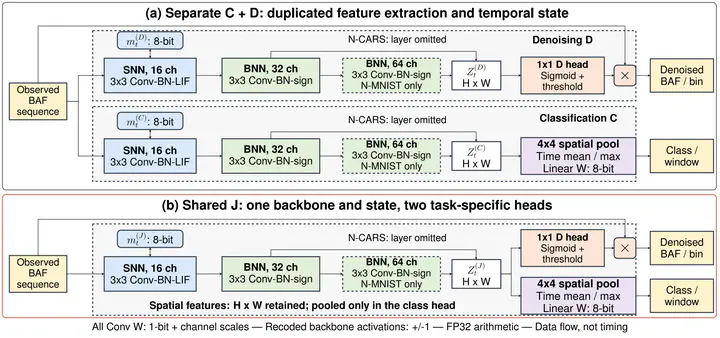
Only the chairs can edit Providing both denoised frames and class decisions from a frame-based event sensor repeats temporal feature extraction when separate networks process the same input. We share one low-bit spiking neural network (SNN)–binary neural network (BNN) backbone, including its membrane evolution, between denoising and classification heads, and quantify what sharing saves and costs against matched separate networks. On binary activity frame (BAF)-converted N-CARS and N-MNIST, layer-shape analysis shows that sharing approximately halves dense weighted terms. Activation traces from fixed 512-sample test subsets yield 51.08% and 47.46% fewer modeled cycles under a common Spatially-Indexed Sparsity-Aware (SISA) microarchitecture model. Across three seeds, denoising F1 is consistently lower than for the separate denoiser, with mean decreases of 0.94 and 1.04 percentage points on N-CARS and N-MNIST, respectively, whereas classification differences change sign across seeds. Both denoisers exceed unchanged noisy-input (identity) F1 over the full frame; on N-CARS, the gains rely mainly on rejecting synthetic noise away from reference (pre-noise) activity. Model/state subtotal savings depend on the separate-network schedule. These results quantify a computation–quality trade-off under the evaluated conditions; physical latency and energy remain unmeasured.

Jaehyeon So (소재현)
PhD student
